M&S Bra Fitting Guide: How to Find the Right Bra Size
Finding the right bra size can make a big difference to your comfort, support and overall shape. A bra that fits well should feel secure without feeling too tight. The cups should hold your breasts comfortably, and the straps should stay in place without digging into your shoulders.
Marks & Spencer, often called M&S, offers many different bra styles, including everyday bras, T-shirt bras, non-wired bras, lace bras, full-cup bras, plunge bras and sports bras. Because different styles can fit differently, knowing your measurements is a useful starting point.
This M&S bra fitting guide explains how to measure yourself, how to check the band and cups, how to adjust the straps and what to do when your bra does not fit properly.
What Makes a Good Bra Fit?
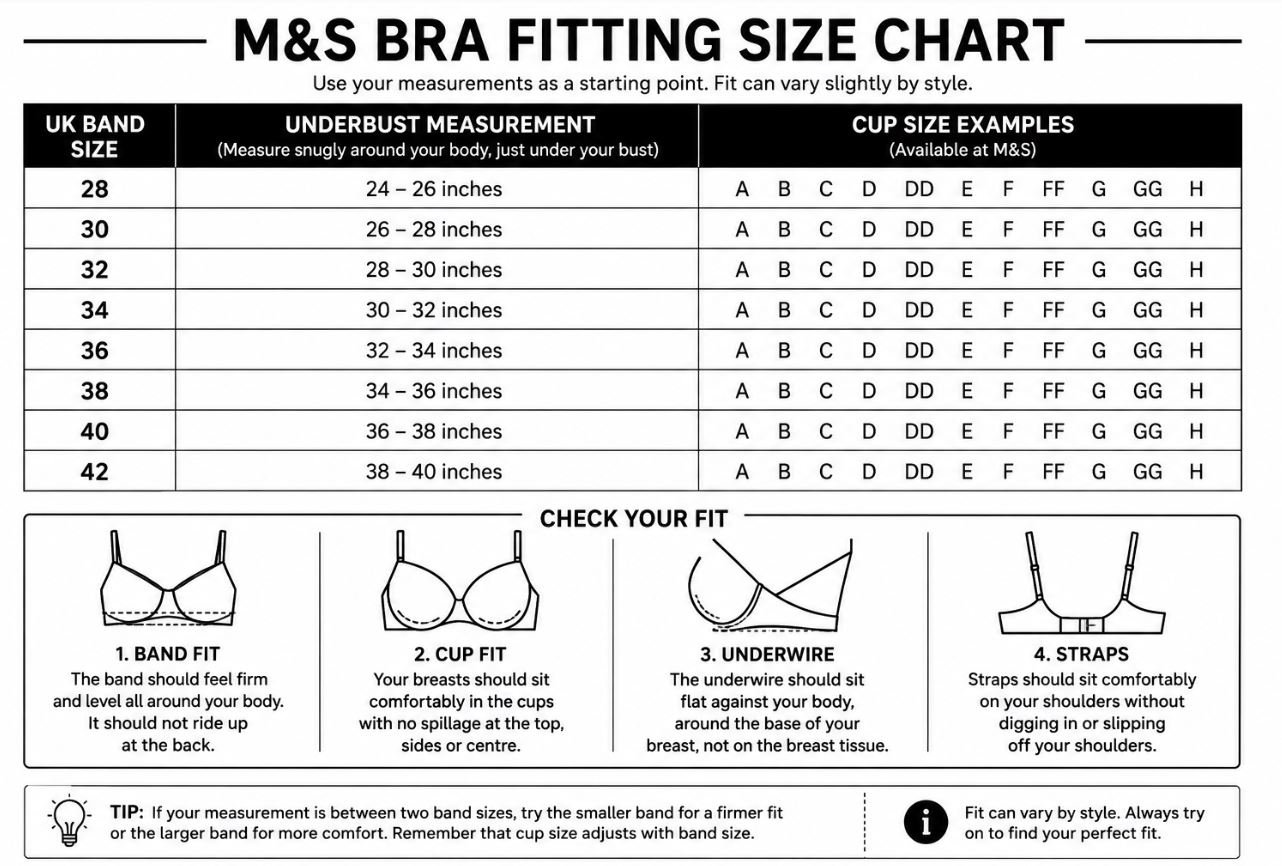
A well-fitting bra should feel comfortable when you move, sit and raise your arms. The band should stay level around your body instead of riding up at the back.
The cups should contain your breasts without spilling over the top or sides. At the same time, there should not be large empty spaces in the cups.
The centre of the bra, between the cups, should sit comfortably against your chest when the style is designed to do so. Underwires should follow the natural shape of your breasts rather than sitting directly on breast tissue.
Your bra straps should provide some support, but they should not carry all the weight. Most of the support should come from the band.
Band
Stays level, doesn't ride up.
Cups
Contain without spilling or gaping.
Centre
Sits close to the chest, where designed to.
Straps
Support, but don't carry all the weight.
How to Measure Your Bra Size
The first step is to take accurate measurements. You can measure yourself at home using a soft measuring tape.
Wear a comfortable, lightly lined or unpadded bra when measuring. Heavy padding can affect the measurements.
Keep the measuring tape flat against your body. It should be snug but not so tight that it digs into your skin.
You normally need two main measurements:
- Your underbust or band measurement
- Your bust measurement
These measurements help you find a starting bra size. However, your final size can vary depending on the bra style and how it is designed.
Measuring Your Underbust and Bust
Measuring Your Underbust
The underbust measurement is taken directly underneath your breasts.
Wrap the tape around your ribcage, making sure it stays level across your back. Breathe normally and keep the tape comfortably snug.
Do not pull the tape extremely tight. You want a measurement that represents how the bra band should sit around your body.
Write down the measurement and use it as a starting point when checking the M&S size information.
Measuring Your Bust
Next, measure around the fullest part of your bust.
Keep the measuring tape level around your body. Do not pull it tightly against your breasts.
The tape should rest gently against your body without compressing the breast tissue.
Take the measurement while standing naturally. Avoid changing your posture or pushing your chest forward because this can affect the result.
Your bust and underbust measurements can then be compared with a bra size chart to find a starting size.
Why Your Bra Size Can Change
Your bra size is not necessarily the same throughout your life.
Body weight, age, pregnancy, hormonal changes and changes in breast tissue can all affect how a bra fits. Even if your measurements have not changed significantly, a different bra design can feel completely different.
This is why it is useful to check your fit rather than relying only on the size printed on an old bra.
A size that worked well in one M&S style may not feel exactly the same in another style.
Checking the Band, Cups, Underwire & Centre Front
Checking the Bra Band
The band is one of the most important parts of a bra.
When you put on a new bra, start with the loosest hook. A new bra should normally feel secure on this setting because the fabric can loosen slightly with regular wear.
Look at the back of the bra in a mirror.
The band should sit in a fairly straight line around your body. If it rides up toward your shoulders, the band may be too loose.
If the band feels extremely tight, leaves deep marks or makes it difficult to breathe comfortably, you may need to consider a different size or style.
A supportive band should feel firm but comfortable.
Checking the Cups
The cups should hold your breasts without causing obvious bulging.
If breast tissue spills over the top, sides or centre of the cups, the cup may be too small. You may need a larger cup or a different bra shape.
If there is a large amount of empty space, the cup may be too large. However, a small gap does not always mean the size is wrong. Cup shape and bra construction can also cause gaps.
For example, a moulded T-shirt bra may fit differently from a soft lace bra even when both have the same size label.
The Underwire Should Sit Correctly
If your M&S bra has underwires, check where they sit.
The wire should follow the natural outside edge of your breast. It should not sit directly on breast tissue.
If the wire feels like it is digging into your breast, try checking the cup size and bra shape.
A wire that sits too far into the breast can be uncomfortable. A wire that extends much farther than your breast may also indicate that the bra shape is not ideal for you.
Comfort is an important part of finding the right bra.
Checking the Centre Front
The centre front is the part between the two cups.
On many wired bras, this area is designed to sit close to the chest. If the centre is pushed away from your body, check whether the cups are large enough and whether the bra shape suits you.
However, not every bra is designed to sit in exactly the same way. Plunge bras, non-wired bras and other styles may have different constructions.
This is why you should consider the design of the bra rather than judging every style by exactly the same rule.
Adjusting Your Bra Straps
Bra straps should be adjusted after you put the bra on.
If the straps are too loose, they may fall from your shoulders. If they are too tight, they can dig into your skin and become uncomfortable.
Adjust both straps gradually.
Your straps should sit comfortably on your shoulders without leaving deep marks.
Remember that tightening the straps cannot fix an incorrect band size. If the back of the bra is riding up, tightening the straps is unlikely to solve the underlying problem.
Common Signs Your Bra Is the Wrong Size
Common Signs Your Bra Is Too Small
There are several signs that a bra may be too small. You may notice:
- Breast tissue spilling over the cups
- Underwires pressing into breast tissue
- A very tight band
- Straps digging into your shoulders
- The centre front being pushed away from your body
- Cups looking stretched or distorted
If several of these problems happen at the same time, try another size or bra shape rather than simply tightening the straps.
Common Signs Your Bra Is Too Large
A bra can also be too large. Possible signs include:
- Large empty areas in the cups
- Cups wrinkling or collapsing
- Straps repeatedly falling from your shoulders
- A band that moves easily around your body
- The back of the bra riding upward
However, cup gaps do not always mean that the cup is too big. Some breast shapes do not fill certain cup designs evenly. Trying another style can sometimes solve the problem without changing your size.
Why Bra Shape Matters
Bra size is only one part of the fitting process.
Breasts come in many different shapes, and bras are also designed in different shapes. Some bras have deeper cups, some have wider cups, and others have more coverage.
A full-cup bra provides more coverage than many plunge styles. A T-shirt bra may have moulded cups designed to create a smooth shape under clothing. A non-wired bra has a different construction from a traditional underwired bra.
If one style does not fit well, that does not necessarily mean your bra size is wrong. Try a different style before assuming that you need a completely different size.
M&S Bra Styles and Fit
M&S sells bras for different needs and preferences. You may find everyday designs, lace styles, non-wired options, sports bras and bras designed for specific levels of coverage.
An everyday bra may be suitable for regular use, while a sports bra is designed to provide additional support during physical activity.
A plunge bra can have a lower centre front, while a full-cup style normally provides more coverage.
Because construction varies between styles, it is important to judge the fit of the actual bra you are wearing.
Not sure where to start?
Take your underbust and bust measurements, then run them through the calculator for an estimated starting size before you try anything on.
Go to the size calculatorWhat Are Sister Sizes?
Sister sizes are bra sizes with different band numbers but a similar cup volume.
For example, when changing the band size, the cup letter may need to change in the opposite direction to maintain a similar cup volume.
Sister sizing can be useful when the cup seems to fit but the band does not feel right.
However, sister sizes should not be confused with UK-to-US or international bra size conversion. Different countries and brands can use different cup-letter systems.
If you are buying an M&S bra, use the sizing information provided for the product rather than assuming that an international size conversion will always be exact.
Wearing, Moving & Remeasuring
How to Put on a Bra Correctly
How you put on a bra can affect the final fit.
Fasten the bra on the loosest hook when it is new. Lean forward slightly and gently move your breast tissue into the cups. This is sometimes called the scoop-and-swoop method.
Make sure the breast tissue is inside the cup rather than sitting underneath the wire or spilling toward the sides.
Then adjust the straps.
Look at the bra from the front and back in a mirror. Check the band, cups, straps and centre front.
This simple process can make a noticeable difference.
Check Your Bra When You Move
Do not check a bra only while standing still.
Raise both arms. Stretch forward. Move your shoulders. Sit down and walk around.
The bra should remain comfortable and supportive during normal movement.
If the band moves significantly, the cups shift or the straps fall repeatedly, the fit may need adjustment.
A good bra should work with your body rather than requiring constant adjustment.
When Should You Measure Again?
There is no single time when everyone needs to measure again.
It is useful to check your measurements when your current bras no longer fit comfortably or when your body has changed.
You may also want to measure again when buying bras after a significant change in weight or body shape.
If you are trying a completely different style, use the measurements as a starting point and then check the actual fit.
Do Not Focus Only on the Size Label
The number and letter printed inside a bra are useful, but they are not the whole story.
The best bra is the one that provides a comfortable fit and the support you need.
Two bras with the same size label can feel different because of differences in fabric, cup shape, wire design, coverage and construction.
This is normal.
Instead of asking only, "What is my bra size?", it can be more useful to ask, "Does this particular bra fit me correctly?"
M&S Bra Fitting Checklist
Before keeping a new bra, check these areas:
Band
It should feel secure and remain level around your body.
Cups
Your breasts should sit comfortably inside the cups without obvious spilling or large gaps.
Underwire
If present, the wire should follow the breast's natural edge without pressing into breast tissue.
Centre
Check how the centre front sits according to the bra's design.
Straps
They should stay on your shoulders without digging in.
Comfort
You should be able to move normally without feeling restricted.
Shape
The bra should create the shape you want under your clothes.
Support
The bra should provide suitable support for its intended use.
Final Thoughts on M&S Bra Fitting
Finding the right M&S bra size is about more than taking one measurement and choosing a number from a chart. Your underbust and bust measurements provide a useful starting point, but the actual bra fit is what matters most.
Check the band first, then look at the cups, underwires, centre front and straps. Pay attention to how the bra feels when you move.
If a bra does not fit correctly, do not immediately assume that your body is the problem. The style, cup shape, fabric or construction may simply not suit you.
M&S offers a wide range of bra designs, so trying different styles can help you find one that matches your body shape, clothing and support needs.
The goal of a good bra fitting is simple: the bra should feel comfortable, stay in place and give you the support and shape you want.