A sports bra that actually holds still.
Two measurements, one impact level, one honest calculator. Get a UK band and cup size matched to the way you actually train — from a gentle walk to full sprint.
The Sports Bra Calculator
Measure over a well-fitting, unpadded bra for the truest result.
Sports Bra Size Calculator: Find the Right Fit for Your Workout
Finding the right sports bra size can make exercise much more comfortable. A sports bra should provide enough support without feeling painfully tight or restricting your movement. Our sports bra size calculator helps you estimate your UK sports bra size using two simple measurements: your underbust and bust measurements.
Whether you enjoy walking, running, gym workouts, cycling, yoga, or high-impact training, starting with the correct bra size can make it easier to choose a suitable sports bra. Enter your measurements into the calculator above to get an estimated UK band and cup size.
How Does a Sports Bra Size Calculator Work?
A sports bra size calculator uses your body measurements to estimate your bra size. The two measurements needed are your underbust and bust.
Your underbust measurement is taken directly underneath your bust, around your ribcage. This helps determine the band size. Your bust measurement is taken around the fullest part of your bust and helps determine the cup size.
The difference between these measurements is used to estimate the cup letter. Together, the band and cup create your UK bra size, such as 32C, 34D, or 36E.
Remember that a calculator provides a useful starting point rather than a guarantee of the perfect fit. Sports bra designs can vary between brands, so it is always worth checking how the bra feels when you move.
Why Is Sports Bra Sizing Important?
A well-fitting sports bra should stay in place while you exercise. If the band is too loose, it may move up your back or fail to provide enough support. If it is too tight, it may feel uncomfortable and make it harder to breathe naturally during exercise.
The cups also need to provide enough coverage. Your breast tissue should remain comfortably inside the cups without spilling over the top, sides, or centre.
Getting your starting size right can make shopping for a sports bra much easier. Instead of guessing between several sizes, you can use your measurements to narrow down your options.
How to Get Accurate Measurements
For the most useful result, take your measurements carefully. Use a soft measuring tape and stand in a relaxed, natural position.
Measure your underbust around your ribcage, keeping the tape level with the floor. The tape should feel snug but should not dig into your skin.
Next, measure around the fullest part of your bust. Keep the tape comfortable and avoid pulling it tightly. Make sure the tape is level around your back.
It can help to take each measurement twice. If the numbers are different, check the tape position and measure again. Small measurement errors can change the calculated size.
You can use centimetres or inches, depending on the measuring system you prefer.
Sports Bra Size for Different Activities
The right sports bra depends not only on your size but also on the activity you plan to do.
For walking, yoga, Pilates, and light exercise, you may prefer a comfortable sports bra with lighter support. Soft fabric and flexible straps can be useful when you want freedom of movement.
For cycling, hiking, dance, and gym workouts, a medium-support sports bra can provide a balance between comfort and stability. Look for a secure band and supportive cups that allow you to move naturally.
For running, HIIT, jumping, and court sports, a high-support sports bra is usually a better choice. These activities involve more movement, so look for features such as supportive cups, a firm underband, secure straps, and good coverage.
Your calculated bra size does not automatically change because you are doing a higher-impact activity. Instead, the construction and level of support of the sports bra should match your activity.
What If Your Sports Bra Feels Too Tight?
A sports bra should feel secure, but it should not cause pain or make normal breathing uncomfortable. If the band leaves deep marks, feels restrictive, or becomes uncomfortable during exercise, check your size and the bra design.
Sometimes the problem is not the calculated size. Sports bras are made with different fabrics, bands, straps, cup shapes, and levels of compression. Two bras with the same labelled size can therefore feel different.
If your measurements place you between sizes, try the recommended size and consider its sister sizes when available. Comparing nearby sizes can help you find a better combination of band comfort and cup coverage.
What If Your Sports Bra Is Too Loose?
A loose sports bra may move during exercise and provide less control. You may notice the band riding up, straps slipping from your shoulders, or breast tissue moving more than you would like.
Before choosing a smaller size, check whether the sports bra is designed for your activity. A lightweight bra may not provide enough support for running or jumping even when the size is correct.
A properly fitted high-support sports bra should feel secure while still allowing comfortable movement.
Use Your Calculator Result as a Starting Point
Your sports bra calculator result gives you a practical UK size to start with when shopping. However, fit is personal, and different sports bras can have different shapes and levels of stretch.
After choosing your estimated size, check the band, cups, straps, and overall comfort. Move your arms, bend, stretch, and walk or jog in place if possible. The bra should stay secure without digging into your skin.
The best sports bra is one that matches both your measurements and your activity. Use the calculator to find your starting size, then use the fit of the actual bra to make your final choice.
Find Your Sports Bra Size Today
You do not need complicated measurements to get started. Enter your underbust and bust measurements into our sports bra size calculator and get an estimated UK band and cup size.
Use the result as a guide when shopping for your next sports bra, and remember to consider the type of exercise you do. With the right size and suitable level of support, you can exercise with greater comfort and confidence.
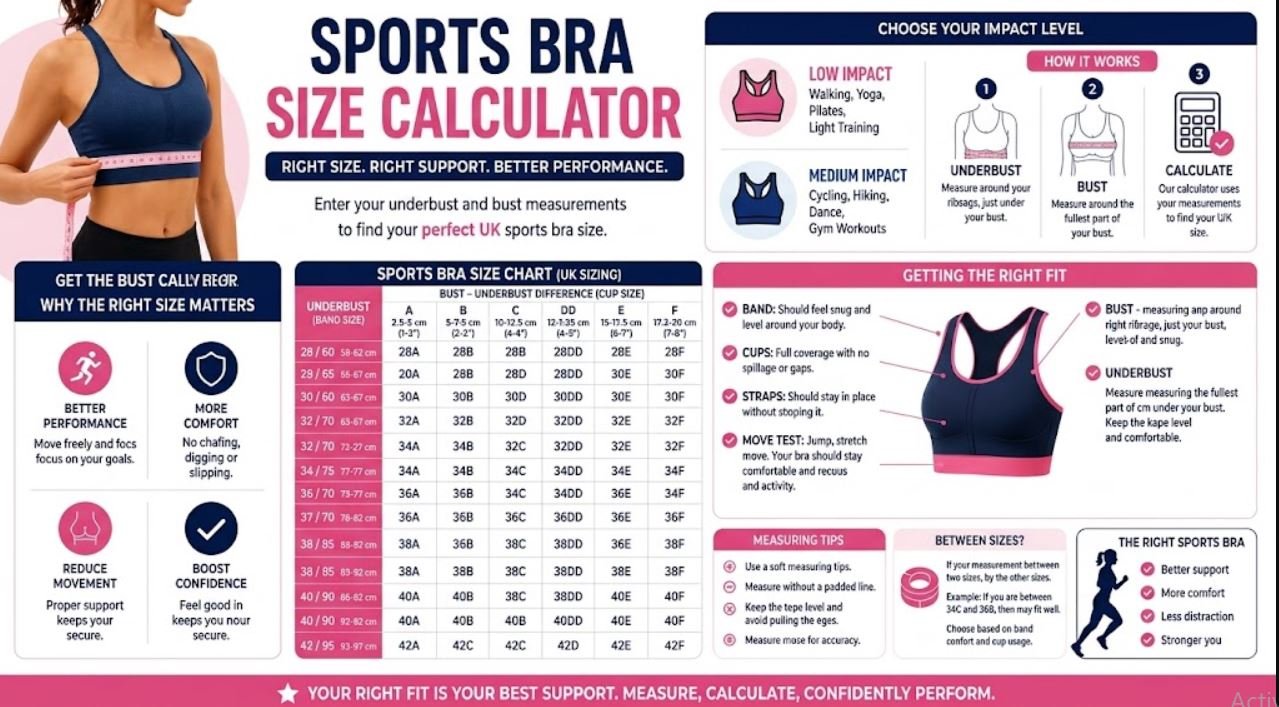
How to measure yourself for a sports bra
Measure the same way you would for any bra — but do it in your regular, relaxed posture, not sucked in or pushed out. A sports bra needs to fit the body that's about to move, not the one standing still for a tape measure.
Find the underbust line
Wearing a non-padded bra, run the tape directly under your bust, parallel to the floor. Pull it snug — firm enough to stay put, not tight enough to dig in.
Measure around the fullest point
Standing naturally, wrap the tape around your back and across the fullest part of your bust. Let it rest — don't pull it flat or let it sag.
Pick your impact level
Be honest about what you'll actually do in it. The size stays the same, but the impact level changes what style and construction we'd point you toward.
Choosing the right impact level
Your band and cup size don't change with impact level — but the amount of control, encapsulation, and strap reinforcement you need does. Here's what each level actually means.
Walking, yoga, pilates, strength training
Movement is slow and controlled, so a lighter compression-style bra with basic support is usually enough.
- Compression (single-layer) construction is fine
- Wider, softer straps for all-day comfort
- Prioritise breathability over rigidity
Cycling, hiking, weight training, dance
A blend of compression and encapsulation gives shape and support without restricting your range of motion.
- Look for moulded or seamed cups
- Wider back band for extra stability
- Adjustable straps to fine-tune fit mid-session
Running, HIIT, court sports, jumping
Vertical, horizontal, and side-to-side movement all need controlling at once — this is where encapsulation matters most.
- Encapsulated cups (individually shaped) over compression alone
- Wide, non-stretch straps that won't slip
- A firm, wide underband that sits below the bust, not on it
Why sports bra sizing needs a different approach
Your size doesn't change, your fit priorities do
A sports bra uses the same UK band-and-cup system as an everyday bra — the number is still your ribcage measurement, the letter is still your cup. What changes is how firmly the band should sit. Because a sports bra is doing more work against gravity and momentum, most fitters recommend going one hook firmer on the band than you would for a T-shirt bra, especially at high impact.
Compression vs. encapsulation
Compression bras flatten breast tissue against the chest as one unit — simple, low-bulk, good for smaller cup sizes and lower impact. Encapsulation bras shape and support each breast individually inside its own moulded cup, which controls movement far better at larger cup sizes or higher impact. Many bras above a UK C or D cup do both at once, which is why they tend to feel bulkier than a compression-only style.
Straps and the back band matter more here
In everyday bras, the band carries most of the support. In sports bras, wide-set, non-stretch straps and a firm, wide back band both share that load, because a narrow strap or a stretchy elastic band will slip or bounce under repeated movement — regardless of how correct your calculated size is.
Sizing up isn't always the fix for bounce
If a sports bra in your correct size still moves too much, the issue is usually construction, not size — a compression-only style being asked to do a high-impact job. Before sizing up, try the same size in a bra built for a higher impact level; it often solves the problem without changing your band or cup at all.
The full UK sports bra size chart
Find your underbust measurement in the left column, then read across to the difference between your bust and underbust to land on a cup letter. This is the same UK band-and-cup grid used across sizing — the fit adjusts by impact level, not by a different chart.
| Band | Underbust (cm) | 0" diff | 1" AA/A | 2" B | 3" C | 4" D | 5" DD | 6" E | 7" F |
|---|---|---|---|---|---|---|---|---|---|
| 28 | 63–67 | AA | A | B | C | D | DD | E | F |
| 30 | 68–72 | AA | A | B | C | D | DD | E | F |
| 32 | 73–77 | AA | A | B | C | D | DD | E | F |
| 34 | 78–82 | AA | A | B | C | D | DD | E | F |
| 36 | 83–87 | AA | A | B | C | D | DD | E | F |
| 38 | 88–92 | AA | A | B | C | D | DD | E | F |
| 40 | 93–97 | AA | A | B | C | D | DD | E | F |
| 42 | 98–102 | AA | A | B | C | D | DD | E | F |
Bands are shown in even numbers only, as UK brands rarely produce odd-numbered bands. If your underbust measurement rounds to an odd number, add one to reach the nearest available band. For high-impact use, many people find their usual band feels more secure one hook firmer than this chart alone suggests.
Understanding sister sizes
A sister size holds the same cup volume as your true size but redistributes it across a different band. In sports bras this is especially handy at higher impact levels, where a firmer band with a slightly smaller cup can feel noticeably more secure than your everyday size.
Going up a band
Move up one band size (say, from 32 to 34) and you'll need to drop one cup letter to keep the same volume — a 32DD becomes a 34D. Worth trying if your current band leaves marks or rides up mid-run.
Going down a band
Move down one band size and go up a cup letter instead — that same 32DD becomes a 30E. For high-impact training, this firmer-band route is often the better starting point over your everyday size.
Signs your sports bra is the wrong size
A calculator gets you close. Try a few star jumps or a short jog on the spot before you buy — these six checks tell you if you've actually landed on the right size and style.
You feel bounce during movement
Any noticeable up-and-down or side-to-side motion means the band or cup isn't controlling movement — try a firmer band, an encapsulated style, or both.
Straps slip off your shoulders
Straps should stay put through a full range of arm motion. If they slide, they're too loose, spaced too wide, or the wrong style for your impact level.
Breast tissue spills over or under the cup
Bulging at the top, sides, or underarm means the cup is too small for the encapsulation it's trying to do — size the cup up before changing the band.
The band rides up during activity
A band that climbs your back mid-workout is too loose for the impact level — go a size firmer, especially for running or court sports.
You feel restricted breathing or moving your arms
Support shouldn't come at the cost of range of motion — if reaching overhead feels genuinely constricted, size up the band rather than tolerating it.
You're constantly adjusting it mid-session
A correctly fitted, correctly built sports bra should need zero mid-workout adjustment. Repeated tugging or repositioning is a fit or construction issue, not something to push through.
Haven't measured yet?
The calculator only takes two numbers and your impact level. Get your estimated UK size, plus sister sizes, in under a minute.
Back to the calculatorFrequently asked questions
Is my sports bra size the same as my everyday bra size?
Usually yes — the underlying UK band and cup measurement doesn't change based on activity. What often changes is fit preference: many people choose a band one hook firmer for high-impact training than they'd wear day to day.
Should I size up or down for running?
Neither, by default — start with your calculated size, then look at construction. If bounce is the problem at your correct size, an encapsulated, high-impact-rated style usually fixes it before a size change would.
What's the difference between compression and encapsulation?
Compression presses breast tissue flat against the chest as a single mass, which works well for lower impact or smaller cups. Encapsulation shapes and supports each breast separately in its own moulded cup, which controls movement better at higher impact or larger cups.
Why does the same size feel different between sports bra brands?
Just like everyday bras, there's no legal sizing standard, so cut, strap width, band construction, and fabric stretch all vary by brand. Treat your calculated size as a confident starting point, then check the six fit signs above.
How do I know which impact level I need?
Match it to your most demanding regular activity, not your gentlest one. If you run once a week and walk the rest, size for running — a high-impact bra will comfortably under-support you for a walk, but a low-impact bra won't hold up for a run.
Can I use one sports bra for everything?
You can, but a bra built for high impact will feel more restrictive and less breathable than necessary for yoga or walking. If your budget allows, most people are better served by one low/medium-impact bra and one high-impact bra.